2026-06-12
Time Words in AI Prompts: Add Emotion and Motion with Past, Present, and Future
Learn how past, present, and future time words make AI image prompts feel more emotional, cinematic, and alive.
Try this workflow in Naviya
Use the guide to shape a still image, then keep it as a first frame or campaign asset.
Open the studio
Many AI image prompts describe space well but forget time. They name the subject, the place, the camera angle, and the style. The result may be polished, but it can feel frozen in the wrong way: like a clean studio pose instead of a moment with a past, a present, and a future.
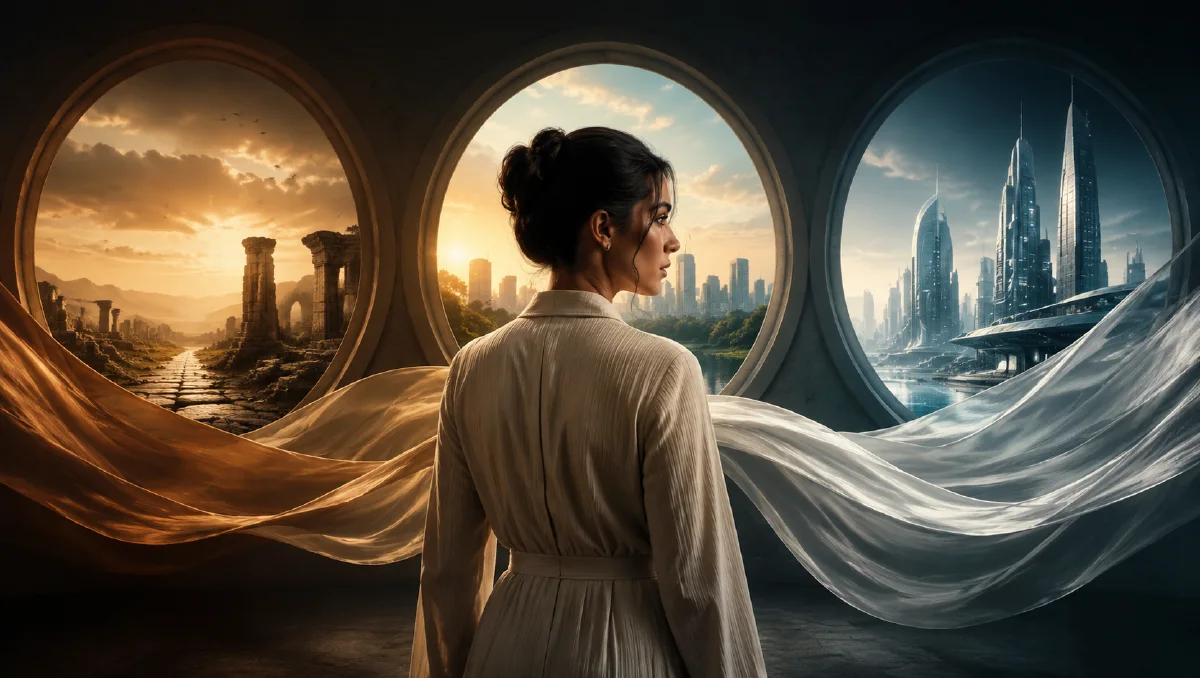
Time words fix that. They tell the model whether the image should show the trace of something that already happened, the force of something happening right now, or the pressure of something about to happen.
This is useful for still images, first frames, and scene planning. If you already use camera language from the AI video prompt guide, time words give that camera something more interesting to catch.
Why time changes the image
An image model does not only place objects. It tries to make the scene believable. When a prompt says "a runner on a street," the model can choose a generic running pose. When the prompt says "a runner who has just finished a rain-soaked sprint," the model has to explain the result: wet hair, heavy breathing, a bent posture, drops on the jacket, and a street that feels recently used.
That is the real value of time language. It creates visual consequences.
Use this base structure:
Subject + place + time state + visible consequence + camera or composition + light.
The time state should be specific. "Dramatic" is vague. "Moments before the storm hits" gives the model a scene to solve.
Past tense: show emotional residue
Past tense works when you want the image to feel lived in. Instead of asking the model to show an action, ask it to show the aftermath.
Weak:
An old man sitting on a bench, cinematic realism.
Stronger:
An old man who has been sitting on this bench for hours, creased coat, tired hands, scattered breadcrumbs near his shoes, empty space where birds have already flown away, late evening light fading, cinematic realism.
The second prompt gives the model a history. The old man is not only "sitting." He has stayed long enough for his clothes to wrinkle, for food to scatter, and for the light to change. The emotional tone comes from those traces.
Past-tense phrases to try:
| Goal | Prompt phrase |
|---|---|
| Nostalgia | after everyone has left |
| Exhaustion | just finished a long shift |
| Battle damage | after the final round |
| Abandonment | untouched for years |
| Memory | as if the room still remembers childhood |
Past tense is especially useful for portraits, deserted rooms, travel scenes, sports images, and product visuals that need use marks instead of showroom perfection.
Present continuous: freeze the decisive instant
Present tense is best for energy. It tells the model to choose a frame inside the action, not before or after it.
Useful phrases include:
- caught mid-action
- caught in the act
- split-second moment
- frozen at the peak of motion
- hair and fabric still moving
- dust suspended in the air
Weak:
A dancer performing on stage.
Stronger:
A dancer caught mid-leap, body arched in the air, hair whipping upward, silk dress rippling outward from the spin, spotlight catching dust particles around her, shadow stretched across the stage floor.
The stronger prompt gives the model several physical clues: hair, fabric, dust, shadow. Those clues make motion visible in a still frame.
This also pairs well with composition. If you want the action to read clearly, combine time words with subject placement from the AI composition prompts guide:
A skateboarder frozen mid-kickflip, positioned on the right third of the frame, board rotating below his feet, diagonal rail leading toward him, late afternoon side light.
The time word creates motion. The composition phrase controls where the motion sits.
Future tense: create suspense
Future tense is the language of tension. It does not show the event. It shows the second before the event.
Weak:
A knight fighting a dragon.
Stronger:
A knight standing before a colossal dragon moments before the breath of fire, dragon inhaling deeply, throat glowing red, shield raised but not yet struck, extreme scale contrast, low angle cinematic shot.
The prompt does not need flames. The glowing throat and raised shield make the viewer complete the next second in their head. That is often more powerful than showing the impact.
Future-tense cues:
- moments before
- about to
- on the edge of
- just before impact
- seconds before the reveal
- before the first drop of rain
- before the door opens
Use future tense for horror, action, cyberpunk standoffs, product launch visuals, sports anticipation, and dramatic first frames. It is also strong for image-to-video because the frame already contains a clear next movement.
Do not mix too many time states
One prompt should usually have one main time state. If a scene is "after the battle," "during the explosion," and "moments before the attack" at the same time, the model has no clean logic to follow.
Better:
A boxer who has just won a brutal final round, exhausted but standing, sweat and blood mixed on her face, hands trembling, harsh overhead arena light.
Confusing:
A boxer before the fight, currently throwing the final punch, after winning, exhausted and fresh, dramatic.
Time is a direction. Pick one direction and let the details support it.
Pair time words with light
Lighting can make the time state easier to read. Past-tense prompts often work with fading light, late afternoon, dim practical lamps, or soft window light. Present-action prompts can use hard side light, stage spotlights, flash photography, or rain-reflected neon. Future-tense prompts like rim light, low angles, silhouettes, and strong contrast.
For more control, use the AI lighting prompts guide to make the light motivated:
Moments before the elevator doors open, a detective stands alone in a narrow hallway, cold fluorescent light above, warm spill from the elevator seam, tense negative space.
The light is not decorative. It supports the story beat.
Time-word editing pass
After generation, check whether the time word is visible without reading the prompt. A "just finished" scene should show residue: steam fading, dust hanging, a chair still moving, wet footprints, or a subject catching breath. A "about to" scene should show tension: a hand near a switch, a runner leaning forward, clouds gathering, or light about to break across a surface. A "while" scene should show active continuity, not a static pose.
If the result misses the time cue, do not add more adjectives. Add physical evidence. Replace "nostalgic past moment" with "sun-faded room, old tape marks on the wall, a half-open box of photographs, dust visible in window light." Replace "future reveal" with "sealed product box on a table, spotlight not yet turned on, hands paused just above the lid." Time becomes legible when the viewer can infer what happened before and what may happen next.
Use the AI image generator for time-specific stills and image to video when the time cue needs motion, such as drifting smoke, a slow blink, or a light turning on.
Try it in Naviya
Draft a still prompt in the AI image generator, then add only one time phrase: "has been waiting for hours," "caught mid-turn," or "moments before impact." Keep the same subject and compare the result.
If the frame suggests a clear next movement, send it into image to video and use a simple motion prompt. Do not repeat every visual detail. Let the image carry the scene and describe only how the moment should move.
A simple time-word checklist
Before generating, ask three questions:
- Is this image about a trace, an impact, or a threat?
- What visible evidence proves the time state?
- Does the camera have a reason to capture this exact second?
If the answer is clear, your prompt will usually feel more cinematic without getting longer. Time words make the model stop producing a clean object and start producing a moment.