2026-06-12
Y2K AI Style Prompts: Digital Flash, Fisheye, Rave Color, and Retro Tech
Create Y2K AI style prompts with fisheye lenses, grainy digital flash, cyber-rave fashion, tattoos, retro tech accessories, and vertical social framing.
Try this workflow in Naviya
Turn a product, hook, or campaign idea into short social-ready ad concepts.
Create video ad variants
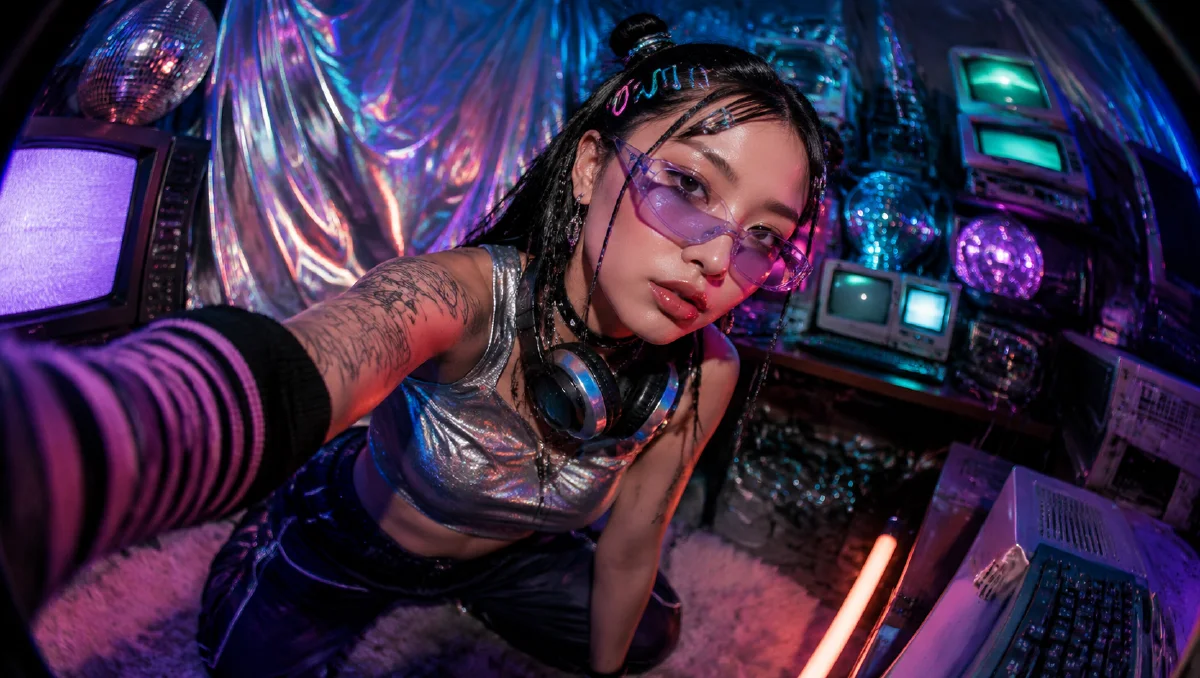
Y2K AI style prompts work when they feel like early digital culture colliding with fashion, rave, punk, and low-resolution futurism. The look is not just "cyberpunk with pink." It has specific camera behavior: harsh flash, grainy ISO, fisheye distortion, close crops, shiny accessories, spiked hair, tattoos, old tech, and vertical framing made for mobile viewing.
The best Y2K images feel slightly too close, slightly too bright, and intentionally imperfect. They borrow from early digital cameras, club flyers, punk portraits, and internet-era futurism. Use this guide with AI camera angle prompts, AI color grading prompts, and controlled chaos AI prompts.
Define the camera first
Y2K style often depends more on camera proximity than on background design. Close-up, low angle, high angle, side profile, macro, and fisheye shots can all work, but each creates a different attitude.
Use a camera block:
Close-up digital flash portrait, fisheye lens, ISO 1200 grain, vertical 9:16 composition, subject leaning toward camera.
Or:
Low-angle wide lens shot, harsh club flash, spiked hair silhouette against neon signs, gritty early-2000s digital texture.
Do not mix every lens. Fisheye and macro are different kinds of distortion. Choose the one that supports the subject.
Make imperfection intentional
Y2K visuals often include grain, flash glare, chromatic edge artifacts, slight blur, blown highlights, and rough digital texture. These should feel like part of the camera era, not like accidental damage.
Useful phrases:
- "grainy retro digital camera texture"
- "harsh on-camera flash"
- "slight chromatic aberration on highlights"
- "compressed early digital photo feel"
- "visible ISO noise in shadows"
- "small blown flash highlights on metallic accessories"
Balance the artifacts with sharp focal details. Keep the eyes, tattoo, sunglasses, or accessory crisp. If everything is noisy and blurred, the output loses style and becomes low quality.
Build the fashion system
Y2K style needs recognizable material and styling cues. Think futuristic sunglasses, tattoo details, metallic fabric, mesh tops, vinyl jackets, chunky headphones, wired earbuds, flip phones, cyber jewelry, sharp hair, bright makeup, and rave accessories.
Prompt example:
Side-profile portrait of a model with chrome wraparound sunglasses, spiked black hair with blue tips, neck tattoo visible, silver mesh top, wired earbuds, harsh flash against a dark club wall, ISO 1600 grain, cyan and hot pink highlights.
The prompt does not just say Y2K. It gives the model concrete surfaces.
For product or brand visuals, use the same cues around the product:
A translucent blue portable speaker photographed with harsh flash on a scratched metal table, flip phone, sticker-covered CD case, chrome chain, hot pink and electric blue club lighting, grainy digital Y2K texture.
The product stays readable while the styling creates the era.
Color: rave, chrome, and flash
Y2K color can be bright, but it should have a source. Neon signs, club LEDs, flash reflections, holographic accessories, and old screens can explain the palette.
Common palettes:
- electric blue, hot pink, and black
- silver chrome, cyan, and white flash
- lime green, violet, and deep shadow
- red club light, blue screen glow, pale skin flash
- monochrome black with one neon accessory
Place the colors:
Electric blue light from the left, hot pink rim light from behind, white flash on the face and chrome sunglasses, background stays dark.
This stops the image from becoming a flat neon wash. If you need repeatability across a campaign, reuse the same palette block across the set.
Use vertical framing
Y2K images often work well in 9:16 because the style is close, body-focused, and social-first. A vertical frame can emphasize hair, face, tattoos, accessories, and posture.
But vertical does not mean center everything. Try:
- face cropped near the top with sunglasses dominant
- low-angle body shot with shoes exaggerated
- side profile leaving negative space for neon signage
- macro accessory detail with background blur
- two-person frame with mirrored posture
Write the crop:
Vertical 9:16 frame, face cropped tightly at the top edge, sunglasses and neck tattoo dominate the composition, background neon blurred.
Cropping makes the image feel designed rather than generated.
From still to Y2K video
Y2K motion should feel like a club camera, phone clip, or fashion teaser. Use short, sharp movements: flash pops, head tilt, hand adjusting sunglasses, camera push, tiny handheld shake, light flicker, or a CD reflecting light.
Video prompt:
The subject slowly tilts the head and adjusts chrome sunglasses. Harsh flash flickers once, neon blue and pink lights pulse softly in the background, fisheye distortion remains stable, gritty digital texture preserved.
Avoid large transformations. If the person, fashion, background, and camera all change at once, the Y2K identity may break. Build the still first, then use image-to-video for small attitude-driven motion.
Common mistakes
The first mistake is confusing Y2K with generic cyberpunk. Cyberpunk can be dark, cinematic, and dystopian. Y2K is often flashier, closer, grainier, more fashion-led, and more tied to early digital photography.
The second mistake is overpolishing. Perfect skin, luxury studio lighting, clean HDR, and glossy CGI remove the era.
The third mistake is using props without camera style. A flip phone alone does not create Y2K. The lens, flash, crop, and texture matter.
The fourth mistake is pushing artifacts too far. Noise, blur, and chromatic aberration should support the frame, not destroy it.
Build Y2K without losing the subject
Y2K prompts can become noisy because the style has so many recognizable signals: flash, chrome, flip phones, low-rise denim, glossy makeup, tiny sunglasses, translucent plastic, starbursts, pixel graphics, and club lighting. Choose three signals and give them roles. One can define fashion, one can define camera, and one can define background. More than that often turns the image into a costume board.
Subject clarity still matters. If the prompt is for a product, keep the product centered and let Y2K appear through flash, props, color, and crop. If the prompt is for a fashion portrait, protect face, outfit, and pose before adding camera artifacts. If it is for a poster, decide whether typography will be added later; generated text can easily become unreadable.
For video, make the motion match the era. A flash pulse, handheld zoom, mirror selfie sway, neon flicker, or slight camcorder shake works better than a modern cinematic orbit. The goal is a believable early-digital attitude, not just a retro filter.
For brands, decide how polished the nostalgia should be. A fashion drop can lean into grain, flash, and attitude. A beauty product may need cleaner skin and more controlled lighting. A tech accessory can use chrome and translucent plastic cues while keeping the product sharp.
If the result feels like generic neon, add era-specific camera behavior before adding more props. Flash falloff, compact-camera blur, sticker-like graphics, and casual framing usually do more than another retro object.
Try it in Naviya
Use Naviya AI Image Generator to build a vertical Y2K still with one camera choice, one light style, and three fashion or tech details. Then use Naviya Image to Video to animate a small gesture, flash pulse, or neon flicker.
Prompt block:
Camera angle, ISO and flash behavior, Y2K fashion details, retro tech props, neon palette with placement, vertical crop, protected sharp detail, avoid clean luxury polish.
Y2K style is not just nostalgia. It is a camera attitude: close, bright, grainy, rebellious, and fascinated by technology that now feels wonderfully obsolete.