2026-06-12
Emotional Montage AI Video Prompts: Show Feeling Through Environment and Contrast
Write AI video prompts that express emotion through environment, contrast, and micro-actions instead of exaggerated facial expressions.
Try this workflow in Naviya
Apply the prompt structure directly inside Naviya video generation workflows.
Plan a video prompt
The fastest way to make an AI video feel staged is to ask the character to display the emotion directly: crying, angry, nervous, depressed, excited. The result often looks like stock footage. The face performs the label, but the scene does not support it.
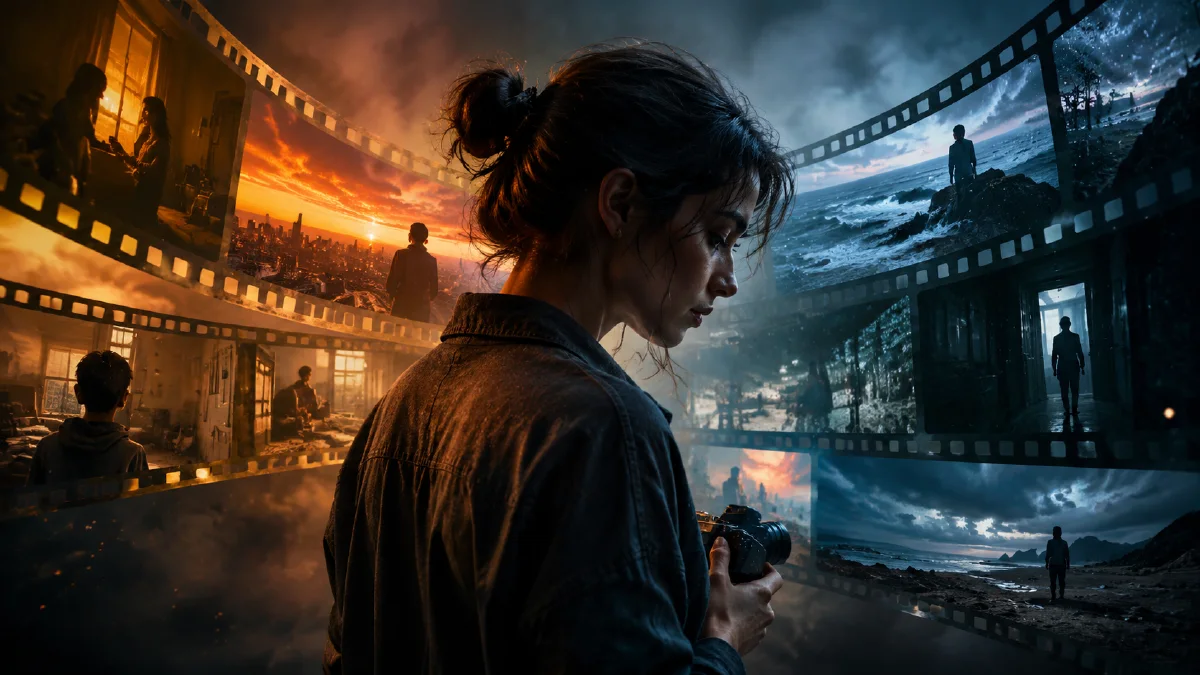
Film emotion usually works differently. Directors make the world carry the feeling. Weather, empty space, light, color, sound cues, stillness, and tiny gestures can say more than a character overacting. For AI video, this matters because models often exaggerate facial expressions when the prompt relies too heavily on emotion words.
Use this guide with Naviya AI Video Generator and Naviya Image to Video. For camera control, read AI video camera movement prompts. For changing emotional states over time, use AI video state flow prompts. For lighting, use AI lighting prompts.
Show emotion through the environment
Instead of telling the model that a character is sad, build a scene where sadness is visible.
Weak:
A young man standing in a room, very sad, crying, depressed, highly detailed.
Better:
Wide cinematic shot of a lonely silhouette sitting with their back to camera in a dim empty apartment. Heavy rain hits the large window, blurring neon city lights outside. A wilted plant sits on the table. Cold blue-gray tones, high contrast, deep negative space, no visible tears.
The better prompt makes the environment the emotional instrument. Rain, blurred neon, empty apartment, wilted plant, cold palette, and negative space all point in the same direction. The character can stay restrained because the world is doing the work.
This technique is useful for grief, loneliness, anticipation, regret, nostalgia, and quiet tension.
Use objects as emotional evidence
A single object can carry backstory when it is placed well.
Examples:
- A birthday cake with untouched candles in an empty kitchen.
- A half-packed suitcase beside an open door.
- A cracked phone screen lighting a face at night.
- A child's toy on a hospital waiting-room chair.
- A wilted bouquet on a hotel bed.
Prompt the object as part of the scene, not as a random prop:
Locked-off medium-wide shot of an empty dining table after a celebration. One chair is pulled back, a slice of cake untouched on a small plate, candle wax running down the side. Warm kitchen light fades into a dark hallway in the background.
The viewer infers emotion from evidence. AI models often respond well to this because the visual task is concrete.
Create emotion through contrast
Emotion becomes stronger when it has a comparison. A loud party followed by silence can express isolation more powerfully than an empty room alone. A bright wedding scene followed by a quiet hand removing a ring creates a stronger emotional shift than simply writing "heartbroken."
For AI video, you can build this as separate shots or as a clear two-part prompt.
Shot A:
Handheld chaotic house party scene, warm orange and red light, crowded room, people dancing close to the lens, blurred motion, strobe flashes, high energy. A young man is pushed gently by the crowd, wearing a forced smile.
Shot B:
Static wide shot outside the same house. The young man sits alone on the curb under a flickering streetlight. The street is empty, cold blue moonlight, large negative space around him, distant warm party light barely visible through the window.
The second shot works because the first shot gave it a reference. The contrast between noise and silence creates the feeling.
If you are generating one short clip instead of two, keep the contrast spatial:
Warm crowded party visible through the window behind him, but the subject sits outside alone in cold blue light, separated from the noise by glass and distance.
Use micro-actions instead of big expressions
Subtle action often feels more real than visible emotional performance. Instead of crying, a person can grip the table edge. Instead of shouting, a person can stop mid-sentence. Instead of panic, a person can tap one finger faster and faster.
Micro-actions work well in AI video because they are small, readable, and less likely to distort the face.
Examples:
Extreme close-up of a hand resting on a wooden table. The fingers slowly curl inward and grip the table edge. Knuckles turn pale under cold overhead fluorescent light. Background completely blurred.
Close-up of a mouth about to speak, then stopping. The subject inhales softly, lips press together, eyes remain out of frame. Shallow depth of field, quiet tension.
Medium shot of a person standing in a doorway, holding a phone. The thumb hovers over the send button but never taps. Warm hallway light behind them, cold room light ahead.
Small actions give the model a precise motion task while leaving emotion for the viewer to complete.
Choose camera behavior for the emotional beat
Camera movement changes how emotion lands.
- Locked-off wide shot: stillness, loneliness, inevitability.
- Slow push-in: realization, pressure, intimacy.
- Handheld close shot: panic, uncertainty, human presence.
- Slow pullback: abandonment, distance, aftermath.
- Side tracking: observation, journey, emotional drift.
Do not choose movement just because video should move. A locked shot can be more emotional than a busy camera if the scene needs stillness.
Example:
Static locked-off wide shot, a woman sits at the far end of a laundromat at night. Fluorescent lights hum overhead, washing machines spin beside her, but she remains motionless. One sleeve of a child's sweater hangs from her hand. No camera movement.
The lack of movement is the point.
Build an emotional montage prompt
Use this structure:
Emotion target + environment evidence + contrast + micro-action + camera behavior + light.
Example:
Emotion target: quiet regret. Static medium-wide shot in a small apartment at dawn. The room is tidy but half-empty, with a single suitcase near the door and a framed photo face down on the table. Cold pale window light fills the room while a warm lamp remains on from the night before. The subject stands still by the doorway, thumb rubbing the handle of the suitcase once, then stopping. No tears, no exaggerated expression.
You can remove "emotion target" from the final prompt once the visible details are strong enough.
Use emotional montage in brand content
Emotional montage is not only for fiction. It can make brand videos feel less literal. A travel product can show relief through a quiet hotel room after a long train ride. A wellness product can show routine through morning light, a glass of water, and a small pause before the day begins. A creator tool can show momentum through a desk changing from scattered notes to a finished storyboard.
The business rule is simple: the emotion must connect to the offer without making an unsupported promise. Show the human moment around the product, not a magical transformation caused by it. Use objects, light, and pacing to suggest the feeling. Then let the product appear as part of the scene rather than a hard interruption.
This makes the final video more flexible. The same emotional sequence can become a launch teaser, a landing-page background, or a social hook if the first frame is clear and the final frame has room for real copy.
Try it in Naviya
Use Naviya AI Video Generator for text-to-video emotional scenes, or animate a carefully composed first frame with Naviya Image to Video. If you are building short-form content, combine these montage ideas with AI video hooks examples so the emotional contrast lands quickly.
Final takeaway
Do not make the character perform the emotion alone. Let the environment, contrast, camera, and micro-action carry the feeling. AI video becomes more believable when emotion is shown as evidence, not labeled as a facial expression.