2026-06-12
AI Miniature Landscape Car Commercial: Build a Cinematic Diorama Ad
Create a miniature landscape car commercial with AI using tilt-shift scenes, mountain roads, controlled vehicle motion, and cohesive editing.
Try this workflow in Naviya
Turn a product, hook, or campaign idea into short social-ready ad concepts.
Create video ad variants
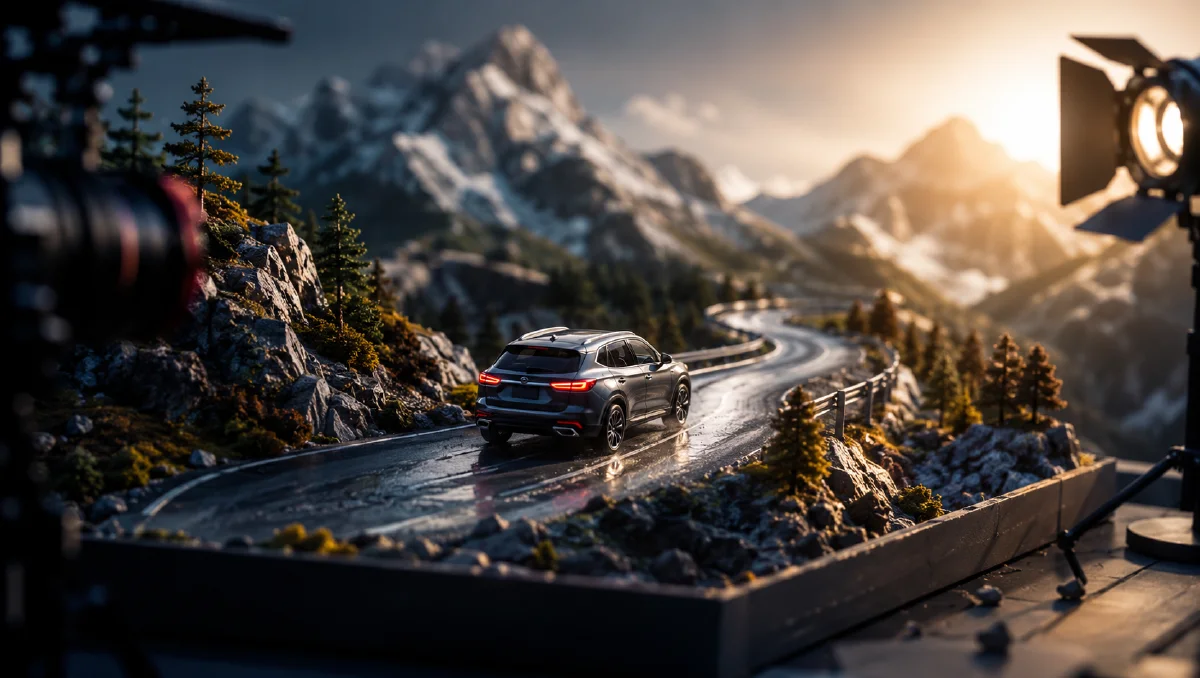
A car moving through a miniature landscape can make a familiar product feel newly imaginative. The contrast is simple: a modern vehicle travels through a tiny crafted world of mountains, pine trees, streams, mist, and winding roads. With tilt-shift style and careful motion prompts, the result can feel like a premium brand film, a collectible diorama, and a travel fantasy at the same time.
The practical definition: an AI miniature landscape car commercial is a short sequence where a vehicle is placed inside a diorama-like environment and animated through controlled camera and scene motion. It can support electric cars, luxury SUVs, compact mobility brands, game trailers, or concept pitches.
If you need broader vehicle prompt ideas, see AI car ad workflow for extreme environments. For camera control, use AI video camera movement prompts. To preserve a specific vehicle shape, combine this workflow with reference to video.
Why the miniature approach works
Miniature scenes let you combine large-scale emotion with small-scale charm. A mountain road, bridge, waterfall, and cloud layer can be arranged like a tabletop set. The vehicle becomes the hero moving through a designed world instead of a normal road shot.
This style is especially useful when you want:
- A distinctive launch teaser.
- A premium mood film without real location shooting.
- A brand concept tied to travel, culture, nature, or precision.
- A social ad that stands apart from conventional driving footage.
The technique depends on three visual ingredients: tilt-shift depth, handcrafted landscape detail, and stable vehicle identity.
Scene ideas
Build a shot list before generating images:
| Scene | Visual purpose | Motion |
|---|---|---|
| Winding mountain road | establishes the tiny world | car drives slowly through curves |
| Misty tunnel entrance | adds mystery and depth | mist drifts, camera pushes in |
| Pine and rock bend | shows vehicle profile | side tracking movement |
| Waterfall bridge | adds premium spectacle | water flows, car crosses bridge |
| Overhead diorama | reveals the full landscape | slow top-down glide |
Use three to five scenes for a short ad. More scenes can dilute the visual memory.
Image prompt template
A tilt-shift miniature diorama of a winding mountain road through an Eastern landscape garden,
a modern white electric SUV driving along the road,
surrounded by tiny pine trees, moss-covered rocks, flowing streams, and misty clouds.
Cinematic lighting, hyper-realistic miniature model quality,
shallow depth of field, jade green and mist white color palette,
premium automotive brand film composition, 16:9.
The vehicle description can change to match your product: white SUV, black luxury sedan, red sports car, silver concept coupe. If the vehicle is brand-specific and you have permission to use its design, use a reference image rather than relying on text alone.
Keep the vehicle readable
Miniature landscapes can become so detailed that the vehicle disappears. To keep the product clear:
- Use contrast between car color and environment.
- Place the car on a visible road line.
- Keep the car larger than strict miniature realism would require.
- Avoid foreground trees covering the body.
- Use one hero side or three-quarter angle.
Prompt addition:
Vehicle remains clearly visible and recognizable, not blocked by trees or mist,
clean three-quarter view, stable proportions, no extra cars.
Turn stills into motion
Each scene should have one vehicle movement and one environmental movement. Example:
The modern white SUV slowly drives along the winding mountain road.
Clouds drift gently between the peaks.
Water flows in the stream beside the road.
Camera follows the car with a smooth slow tracking movement.
Miniature tilt-shift depth remains consistent.
For a waterfall bridge:
The car crosses the small stone bridge at a calm speed.
Water flows below, mist rises softly, pine branches move slightly.
Camera glides from front-left to side profile.
Vehicle shape stays stable, no warping, no extra vehicles.
For an overhead shot:
Top-down tilt-shift view of the full miniature landscape.
The car follows the winding road slowly while clouds drift between tiny mountains.
Camera descends slightly, smooth and cinematic.
Editing structure
A 20-second commercial can follow this sequence:
| Time | Shot |
|---|---|
| 0-4 seconds | overhead reveal of miniature landscape |
| 4-8 seconds | car enters winding road |
| 8-12 seconds | side profile through pine and rocks |
| 12-16 seconds | bridge and waterfall hero movement |
| 16-20 seconds | final vehicle beauty shot with logo space |
Use sound design such as soft wind, water, distant tires, and understated music. Avoid aggressive engine audio if the visual language is calm and miniature.
Adapt the route to the brand
The miniature world should say something about the car. A luxury SUV can travel through misty mountain roads and stone bridges to suggest comfort and capability. A compact city car might move through a miniature urban block with tiny storefronts and clean morning light. A performance coupe may need sharper roads, darker rock, and stronger contrast. The diorama style is flexible, but the route should match the product promise.
You can also use the landscape as a metaphor. A winding path suggests exploration. A bridge suggests connection. A tunnel suggests reveal. A high overlook suggests confidence. Pick one metaphor and repeat it through the edit so the commercial feels intentional.
Vehicle consistency tips
If the vehicle changes across shots, reduce environmental complexity and use a cleaner three-quarter view. Add the same color, body type, wheel style, and lighting phrase to every prompt. When possible, generate or refine all hero frames from the same reference image. The viewer may forgive a different tree or cloud, but they will notice if the vehicle silhouette changes.
Use scale cues carefully
Scale cues make the diorama believable: tiny trees, small bridge rails, miniature road texture, moss that reads like a model surface, and shallow focus that blurs the far background. Use too many, and the car may feel like a toy. Use too few, and the scene becomes a normal landscape shot. The best balance is a realistic vehicle inside a crafted world, not a toy car in a toy set.
Prompt modifiers for stronger diorama style
| Need | Add |
|---|---|
| More miniature feel | "tilt-shift photography, shallow depth of field, handcrafted model quality" |
| More cultural landscape mood | "pine trees, moss rocks, mist, flowing stream, jade green palette" |
| More premium car feel | "cinematic automotive lighting, clean reflections, elegant body highlights" |
| More stability | "vehicle proportions remain stable, no morphing, no extra vehicles" |
| More motion | "slow tracking camera follows the car, clouds drift gently" |
Be careful with over-decoration. If every shot has waterfalls, fog, clouds, bridges, flowers, and dramatic lighting, the vehicle may become secondary.
Try it in Naviya
Use Naviya Image Generator to create the diorama scenes, then animate approved frames in Naviya Image to Video. For a specific vehicle, use Naviya Reference to Video. If you want to test a campaign cut, build a quick concept in Naviya AI Video Ads.
Final checklist
Before exporting, verify:
- The vehicle remains recognizable in every hero shot.
- The miniature effect is consistent.
- Camera motion is slow and premium.
- Environmental motion supports the car rather than distracting from it.
- The edit has a clear journey from reveal to hero frame.
- No scene implies official affiliation with a real brand unless you have rights to use it.
A miniature landscape car commercial is not just a novelty style. It is a controlled way to make mobility feel poetic, crafted, and memorable. The best results come from a simple shot list, consistent tilt-shift language, and disciplined vehicle preservation.