2026-06-12
Shot Emotion in AI Prompts: Match Lens, Distance, and Composition
Write AI image and video prompts where shot size, focal length, and composition support the emotion instead of fighting it.
Try this workflow in Naviya
Use the guide to shape a still image, then keep it as a first frame or campaign asset.
Open the studio
AI prompts often fail because the emotional idea and the camera language disagree. A prompt asks for loneliness but frames the character in a tight beauty close-up. It asks for joy but places the subject in a distant landscape where the face is unreadable. It asks for realism but combines a wide-angle lens, close-up face, telephoto compression, and "epic cinematic composition" in the same sentence.
The model is not only generating a subject. It is generating a point of view. Shot size, lens choice, and composition tell the viewer how to feel about what they see. If those choices conflict, the result feels staged or emotionally flat.
Use this guide with image generation, AI video, and first-frame planning for image to video. For a broader camera reference, read AI camera angle prompts. For lighting support, use AI lighting prompts.
Shot size controls psychological distance
Shot size answers one question: how close is the viewer allowed to be?
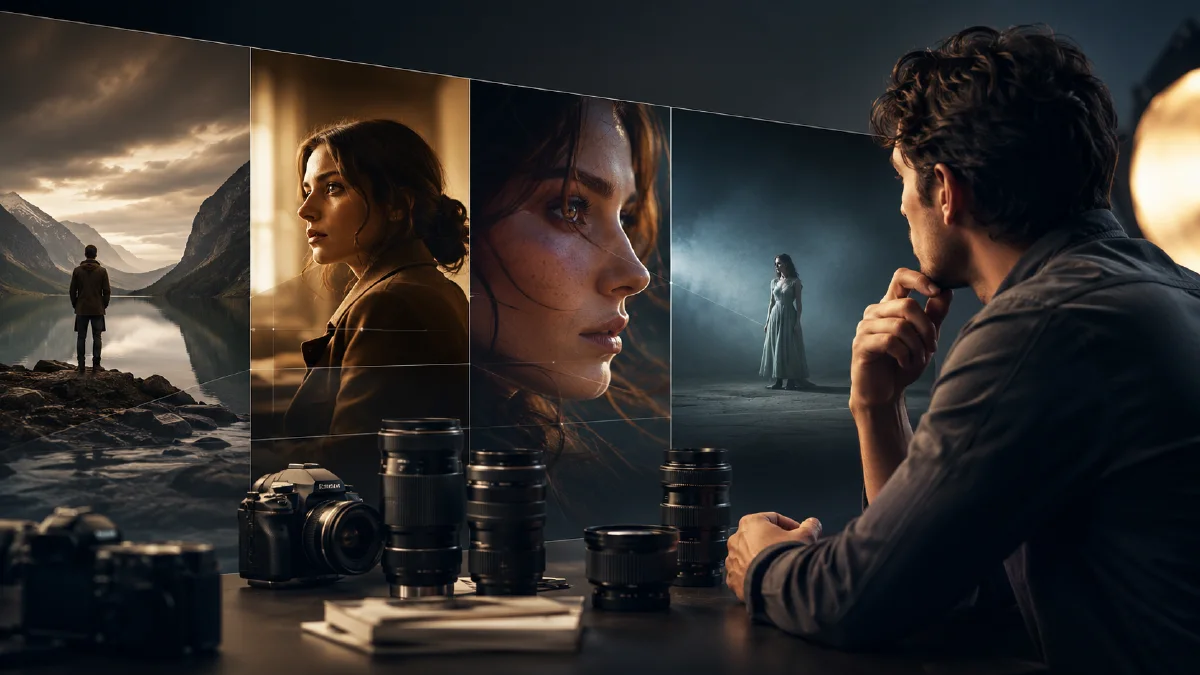
An extreme wide shot reduces personal detail and increases environment. It is useful for isolation, scale, fate, danger, and epic context. A close-up removes the escape route. It forces the viewer to read expression, skin, eyes, breath, and tiny movement.
Choose shot size before adding style words.
Wide shot: emotion through environment
Use wide shots when the world should dominate the subject.
Extreme wide shot of a tiny lone figure in a dark coat crossing a vast snowy field beneath a heavy overcast sky. The figure occupies only a small part of the frame, surrounded by white emptiness, muted color, deep loneliness, cinematic scale.
This works because loneliness is expressed by spatial proportion. The person is not saying "I am lonely." The frame says it.
Wide shots are weak for emotions that depend on facial expression: panic, surprise, intimate joy, subtle grief. If the face matters, move closer.
Medium shot: social and narrative distance
Medium shots are close to how we experience people in daily life. They show expression, posture, hands, and some environment. Use them for conversation, lifestyle content, creator videos, product demos, calm storytelling, and realistic scenes.
Medium shot at human height, a creator sits at a desk beside a product prototype, one hand resting near the object, soft window light from camera left, background shelves visible but subdued.
Medium shots are often the safest starting point for social video because they balance character and context.
Close-up: forced empathy
Close-ups are emotional pressure. Use them when the viewer must read detail.
Extreme close-up of a woman's face, one eye in sharp focus, a tear catching warm backlight, the far side of the face softening into shadow, shallow depth of field, 85mm lens.
The close-up works because it removes the environment. The viewer cannot avoid the emotion.
Do not use close-ups when the point is scale, journey, or spatial danger. For those, the environment needs room.
Lens choice changes the psychology of space
Lens prompts are not decoration. A 16mm lens and an 85mm lens can describe the same subject with completely different emotional effects.
Wide lenses exaggerate space
Wide lenses, especially below 24mm, stretch perspective. Objects close to the camera feel large. Corridors feel longer. Faces near the lens can become distorted. This is useful for unease, speed, pressure, absurdity, and epic environment.
Ultra-wide 16mm low-angle shot, a character's face close to the lens, slightly distorted by perspective, a long fluorescent hallway stretching behind them, harsh green overhead light, anxious institutional mood.
Use wide lenses carefully for beauty, fashion, or product detail. Distortion may hurt the subject unless it is intentional.
Standard lenses feel observational
35mm and 50mm prompts often feel close to human observation. They are useful for documentary, lifestyle, travel, creator content, and natural storytelling.
35mm eye-level medium shot, handheld documentary feel, natural room perspective, subject moving through a small studio while morning light falls across the floor.
If you want a scene to feel believable instead of stylized, a standard lens is often the right anchor.
Telephoto lenses compress and isolate
Long lenses, such as 85mm, 135mm, or 200mm, compress space. Backgrounds feel closer to the subject, and the viewer can feel hidden or distant. This is useful for isolation, surveillance, romantic portraits, or a character surrounded by a crowd but emotionally separate.
200mm telephoto shot of a woman walking alone through a crowded street. The background crowd compresses into a blurred wall of faces, while she remains in sharp focus, isolated despite the crowd.
Telephoto prompts are strong when the subject should feel watched or separated.
Composition shows power relationships
Composition tells the viewer who has control.
Centered composition suggests order, authority, ritual, or confidence. Off-center composition can suggest imbalance, uncertainty, or vulnerability. A Dutch angle introduces instability. Frame-within-a-frame can suggest privacy, surveillance, memory, or entrapment.
Examples:
Centered symmetrical composition, the founder stands alone at the end of a clean black corridor, equal negative space on both sides, confident and controlled.
Frame-within-a-frame composition, a woman seen through a narrow gap between two dark walls, standing in a pool of light at the end of an alley, watched from a hidden position.
Composition should serve the emotion. Do not use a beautiful centered frame if the scene is supposed to feel unstable.
Build the emotion from camera first
Try this structure:
Emotion target -> shot size -> lens -> composition -> light -> subject action.
Example for isolation:
Emotion target: isolation.
Extreme wide shot on a 35mm lens, high negative space, the subject small in the lower third of the frame, sitting alone at a bus stop at night. Cold blue streetlight above, empty road stretching into darkness, soft rain on the pavement, no other people.
Example for panic:
Emotion target: panic.
Close-up on a 24mm lens, slightly distorted perspective, camera very close to the subject's face, eyes wide, breath visible in cold air. Background corridor stretches sharply behind them, harsh fluorescent light, handheld tension.
The emotion target can be removed from the final prompt if the visible instructions are strong enough. Use it as a planning line.
A quick shot test exercise
To learn shot emotion, generate the same subject three ways. Keep the person, location, and light similar, then change only the camera relationship:
- Extreme wide shot with the subject small in the frame.
- Eye-level medium shot with balanced negative space.
- Close 24mm shot with the camera near the face.
Compare the feeling before changing style. The wide frame may feel lonely or peaceful. The medium frame may feel observational. The close wide-lens frame may feel tense or intimate. This exercise proves that emotion can come from camera distance before acting, color, or props.
For video, animate the version that already carries the right feeling as a still. If the close shot feels anxious, add a tiny handheld drift. If the wide shot feels lonely, keep it locked and let rain, light, or traffic move around the subject. Motion should amplify the camera choice, not replace it.
Try it in Naviya
Use Naviya Image Generator to test shot emotion as still frames. When a frame carries the right feeling, move it into Naviya Image to Video and add one clear motion idea. For text-first scenes, open Naviya AI Video Generator and pair this camera structure with the AI video state flow prompts guide so the emotion changes cleanly over time.
Final takeaway
Emotion is not only an actor's expression. It is where the camera stands, how far the viewer is, how space bends, and how the frame assigns power. Match shot size, lens, and composition to the feeling before adding style words.