2026-06-12
AI Brand Story Short Film Workflow: From Loose Idea to Finished Concept
Turn a loose brand story idea into an AI-generated short film with a dramatic premise, three-act structure, storyboard prompts, and video assembly.
Try this workflow in Naviya
Apply the prompt structure directly inside Naviya video generation workflows.
Plan a video prompt
Many brand videos begin as vague ideas: a rainy night, a forgotten object, a person at a turning point, a product that changes the mood. The challenge is not generating visuals. The challenge is finding the emotional hook that gives the visuals a reason to exist.
The practical definition: an AI brand story short film is a compact narrative built from a clear dramatic question, a three-act structure, generated storyboard frames, image-to-video clips, and final editing. It can support brand campaigns, founder films, product teasers, recruiting stories, or social content.
For visual prompt structure, read AI visual brief to prompt. For turning storyboard frames into motion, use the image to video workflow guide. For more short-form hooks, see AI video hooks examples.
Start with a stronger premise
A weak premise:
A person finds something on a rainy night.
A stronger premise:
On a rainy night, a burned-out office worker finds a childhood diary that records a dream they abandoned years ago.
The second version adds three things:
- Character: burned-out office worker.
- Object: childhood diary.
- Emotional conflict: forgotten dream versus present life.
This is the difference between an atmospheric clip and a story. The brand does not have to appear immediately. It can enter through the theme: creativity, courage, memory, renewal, connection, or transformation.
Use the dramatic question
Every short film benefits from a dramatic question:
Will the character ignore the diary and continue their routine, or will they reclaim the dream they forgot?
For a brand, the question should connect to the audience's desire. A creative tool might ask whether the character will make again. A wellness brand might ask whether they will return to themselves. A productivity app might ask whether they will regain control of time.
Prompt template:
Create a 3-minute brand short film concept.
Core setting: [place and mood].
Main character: [specific person and emotional state].
Special object: [object that changes the story].
Emotional theme: [memory, courage, renewal, focus, connection].
Dramatic question: [will they choose X or Y?]
Brand role: [subtle helper, final reveal, symbolic value, product in use].
Output: logline, three-act outline, key scenes, visual mood.
Build a three-act spine
A short film does not need a complex plot. It needs progression:
| Act | Function | Example |
|---|---|---|
| Act 1 | normal life and disruption | rainy commute, character finds diary |
| Act 2 | memory and conflict | childhood dream appears through visual fragments |
| Act 3 | choice and transformation | character creates, returns, or takes action |
This structure can fit a 30-second ad or a three-minute concept. The difference is how many beats you include.
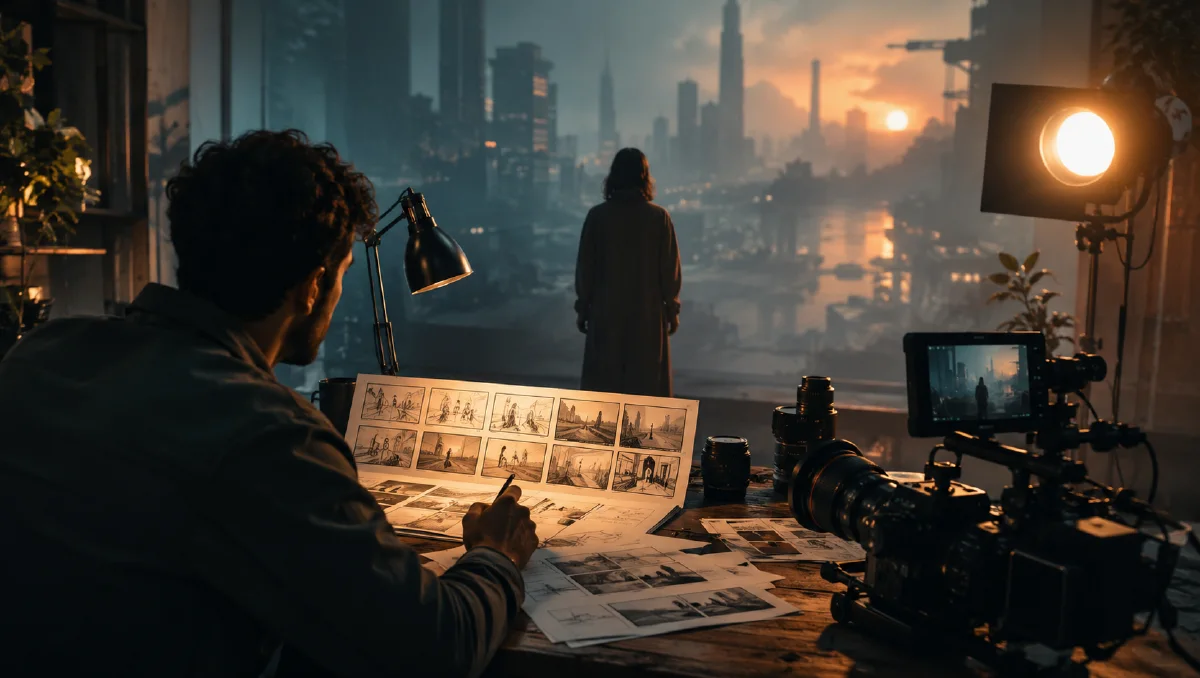
Turn the story into storyboard shots
Storyboard prompt:
Turn this brand short film outline into a 10-shot storyboard.
For each shot include: duration, camera angle, subject, action, lighting, mood, and transition.
Keep the visual style cinematic, rainy, emotionally restrained, and realistic.
Use recurring motifs: rain on glass, notebook pages, warm childhood memory light, office reflections.
Possible shot list:
- Wide shot of late office windows in rain.
- Medium shot of character leaving work, tired expression.
- Close-up of diary lying near puddle.
- Character opens diary under street light.
- Flash of childhood drawing in warm light.
- Present-day room filled with muted gray tones.
- Diary pages glow softly with remembered sketches.
- Character begins making something again.
- Morning light replaces rain.
- Final brand or product frame tied to renewed action.
Generate consistent storyboard frames
Use a repeated style block:
cinematic realistic short film, rainy night, soft reflections,
muted blue-gray palette with warm memory highlights,
shallow depth of field, emotional restraint, premium brand storytelling
Example frame prompt:
Medium shot of a tired office worker standing under a street awning at night,
rain falling behind them, wet pavement reflections, one hand holding an old diary,
muted blue-gray city light with a small warm glow from the diary pages,
cinematic realistic short film style, emotional restraint.
For memory scenes:
Close-up of a child's sketchbook page on a wooden desk,
warm afternoon light, colored pencil drawings of a future dream,
soft nostalgic atmosphere, shallow depth of field,
cinematic brand story visual.
Animate with emotional restraint
Motion prompts should be simple:
Rain falls gently in the background.
The character slowly opens the diary.
Warm light reflects softly on their face.
Camera pushes in slightly, no sudden motion.
For memory fragments:
The camera glides over the sketchbook page.
Warm light moves across the paper.
Dust particles drift subtly, nostalgic mood.
The story should not rely on chaotic effects. Emotion comes from timing, reaction, light, and contrast.
Where the brand appears
There are several ways to place the brand:
| Brand role | How it appears |
|---|---|
| Tool | character uses the product to make or finish something |
| Symbol | product color, shape, or motif appears subtly throughout |
| Guide | product helps recover memory, focus, or connection |
| Final reveal | brand appears only after the story resolves |
Avoid forcing the product too early if the story depends on emotion. For many brand shorts, a subtle final reveal can be stronger than constant product placement.
Keep the story visually repeatable
A short film becomes easier to generate when it has recurring visual motifs. Choose two or three: rain on glass, a diary page, warm light, a color accent, a hand gesture, or a specific location. Repeat them across the storyboard so the edit feels connected even when shots are generated separately.
Motifs also help the viewer understand the story without heavy narration. A warm diary glow can stand for memory. A gray office reflection can stand for routine. Morning light can stand for a new choice. When the symbols are clear, the brand message feels earned instead of explained.
Edit the film
Use music and pacing to separate present and memory:
- Present: rain, low ambience, cool color.
- Memory: warmer tone, softer sound, slower cuts.
- Choice: silence or reduced music.
- Resolution: clearer light, cleaner framing.
If the film is for social, create a shorter cut with the object discovery in the first two seconds.
Plan both narrative and campaign versions
Create two edits from the same material. The narrative version can hold quiet moments and let the emotional turn develop. The campaign version should lead with the strongest object or reveal, then move quickly to the brand role. This lets the story serve both viewers who want emotion and viewers who are deciding whether to click.
When planning the storyboard, mark which shots are essential for the story and which shots are useful for marketing. Essential shots carry the character arc. Marketing shots show the product, outcome, or brand line. A good short film usually needs both.
Try it in Naviya
Use Naviya Image Generator to create storyboard frames, then animate them with Naviya Image to Video. For text-first scene experiments, use Naviya Video Generator. If a character, product, or style motif must remain consistent across shots, use Naviya Reference to Video.
Final checklist
Before producing the full cut, confirm:
- The premise has a clear dramatic question.
- The character has a specific emotional state.
- The object matters to the story.
- The brand role is subtle but understandable.
- Each shot has one clear action.
- The visual style repeats across the sequence.
- The ending changes the viewer's understanding of the character.
AI can catch a loose idea and help shape it, but the story still needs a human decision: why should this moment matter? Once that answer is clear, prompts, images, motion, and editing all become easier.