2026-06-12
AI Skincare UGC Video Keyframe Workflow: Keep One Creator Stable
Create AI skincare UGC videos with a keyframe chain workflow that preserves one creator, product, background, and natural talking performance.
Try this workflow in Naviya
Turn a product, hook, or campaign idea into short social-ready ad concepts.
Create video ad variants
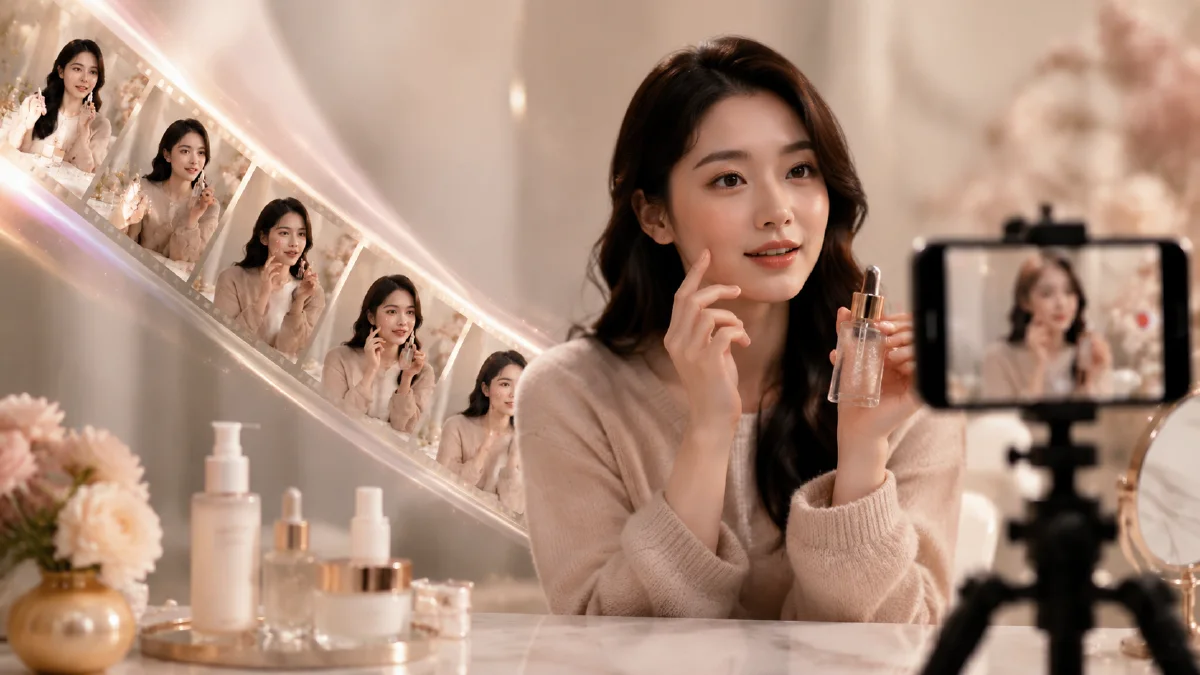
AI skincare UGC videos often fail for one reason: the creator changes from shot to shot. The face shifts, the bathroom changes, the product becomes a different bottle, or the lighting stops matching. A keyframe workflow solves this by designing a chain of still frames first, then animating each short segment from one frame to the next. The final edit feels like a continuous creator video because identity, wardrobe, background, and product stay anchored.
This workflow is useful for beauty routines, skincare reviews, serum demos, toner ads, cleanser explainers, and product launch clips. Related guides include UGC AI video ad prompts, micro-expression AI video prompts, and image to video troubleshooting.
Why keyframes help skincare UGC
Skincare UGC usually includes several beats:
- Hook expression.
- Product reveal.
- Texture or application gesture.
- Face or skin close-up.
- Closing reaction.
If you ask for all of this in one long video, the model must maintain identity, product, hands, speech, and scene for too long. Keyframes break the problem into smaller transitions. Each still frame defines where the creator starts and where the creator ends. The video model only needs to animate the gap.
Plan the creator and setting
The first frame is the anchor. It should feel like real phone footage, not a glossy studio portrait. For beauty UGC, believable imperfections help: a real bathroom shelf, natural daylight, a towel, a plant, or a slightly busy vanity. Do not add social app UI, captions, or fake comments inside the generated video.
First frame prompt:
Create a vertical smartphone selfie first frame for a skincare UGC ad.
Creator: young adult beauty creator looking surprised and excited, natural skin texture, no heavy filter.
Wardrobe: simple red or neutral top, consistent throughout the video.
Scene: real bedroom vanity or bathroom with natural daylight, slightly lived-in background.
Camera: phone selfie close-up, realistic lens distortion, eye contact with camera.
Constraints: no TikTok UI, no subtitles, no text overlays, no perfect studio lighting.
Once this frame works, reuse it as the visual reference for every later keyframe.
Create the keyframe chain
A five-frame skincare UGC chain can look like this:
| Keyframe | Action | Purpose |
|---|---|---|
| A | Creator reacts to camera | Hook |
| B | Creator holds product near face | Product reveal |
| C | Creator touches cheek or shows texture | Use moment |
| D | Creator leans closer and points to skin | Proof-style visual |
| E | Product on counter, creator waves or smiles | Close |
Each frame should preserve wardrobe, background, camera angle, and product. Change only the action and expression. If the background changes too much, simplify the prompt and explicitly say "same room, same camera position, same lighting."
Keyframe B prompt:
Using the same creator, outfit, room, camera angle, and lighting, create the next keyframe.
The creator leans slightly toward the phone camera, smiles, and holds the skincare bottle beside the cheek.
The product is visible but label text is not readable.
Keep the same background objects and natural phone-camera look. No UI or subtitles.
Keyframe C prompt:
Using the previous keyframe as reference, create the next keyframe.
The creator places the bottle on the vanity and lightly touches one cheek with fingertips.
Expression: pleased and conversational, still looking near the camera.
Preserve face, top, room, product bottle, lighting, and phone perspective.
Animate frame-to-frame segments
After the keyframes are approved, animate short segments:
Animate keyframe A to keyframe B into a 4 second vertical UGC skincare clip.
The creator talks excitedly to the phone camera, then lifts the product beside the face.
Speech: "I added this to my morning routine because it feels light and easy to layer."
Camera: phone selfie, natural handheld micro-movement.
Constraints: preserve creator identity, red top, room, product bottle, and natural skin texture. No UI, no subtitles, no fake label text.
For the application segment:
Animate keyframe B to keyframe C into a 4 second vertical UGC skincare clip.
The creator lowers the bottle to the vanity and lightly touches the cheek while speaking naturally.
Speech: "It absorbs quickly and does not feel sticky under my moisturizer."
Motion: simple hand movement, no rubbing, no dramatic skin transformation.
Constraints: preserve identity, product, background, and hand realism.
Keep each segment short. Four seconds is enough for a sentence and one motion. Longer clips increase drift.
Write skincare-safe speech
Skincare UGC can sound natural without making unsupported claims. Use sensory and routine language:
- "Feels light."
- "Layers easily."
- "Works well in my morning routine."
- "Leaves a fresh finish."
- "I like the texture."
- "My skin looks more awake in this routine."
Avoid medical or guaranteed result language:
- "Cures acne."
- "Removes scars."
- "Erases wrinkles."
- "Works instantly for everyone."
- "Clinically fixes dullness" unless that claim is approved and documented.
The creator can sound excited, but the claims should stay controlled.
Edit the one-take illusion
When the segments are generated, trim the first and last few frames of each clip if motion freezes. Place segments in order and use direct cuts or very short overlaps. Add captions in the editor. Match volume, color, and crop across segments.
Do not worry if the clip is not truly one continuous take. The viewer cares that it feels consistent and understandable. A clean five-segment edit is better than one long clip where the creator's face drifts.
Script the keyframes around proof
A skincare UGC clip should not be built around vague beauty language. Choose one proof moment and let the keyframes support it. For a moisturizer, the proof might be texture, application, finish, and reaction. For a cleanser, it might be foam, rinse, clean skin feel, and bathroom shelf packshot. For a serum, it might be dropper, glide, glow, and routine placement.
Write one sentence for each keyframe before generating. Keep claims practical: "lightweight texture," "absorbs quickly," "fresh morning routine," or "dewy finish." Avoid overpromising medical or transformation claims unless they are approved elsewhere in the campaign. If the video needs captions, leave clean upper-frame space and add the words in editing so product names and benefits stay readable.
Review the chain as a viewer, not just as a producer. The first keyframe should make the routine obvious, the middle frames should show product handling, and the final frame should feel like a natural conclusion rather than a random beauty pose.
Try it in Naviya
Use Naviya AI Video Ads to test hooks and short skincare scripts. Build keyframes from product and creator references, then animate each segment with Image to Video. Use Reference to Video when the same creator, bathroom, product, and wardrobe must stay stable across the whole chain.
For the first workflow, create only three keyframes: hook, product reveal, and close-up. If those are stable, add texture and closing reaction frames.
Final checklist
- The first frame establishes the creator, room, and phone-camera style.
- Every keyframe preserves identity, outfit, product, and background.
- Each segment has one motion and one speech line.
- Product label text is not hallucinated.
- Skin claims are sensory, routine-based, or approved.
- Captions are added in editing, not generated into the video.
A keyframe chain turns AI skincare UGC from a guessing game into a controlled production method. The model still creates motion, but the creative team decides the story beats before anything moves.