2026-06-12
Unique Photography AI Prompts: Make Images Feel Shot, Not Generated
Use unique photography AI prompts for unconventional angles, creative light, double exposure, selective color, and experimental photo concepts.
Try this workflow in Naviya
Use the guide to shape a still image, then keep it as a first frame or campaign asset.
Open the studio
Unique photography AI prompts are about making the image feel like someone made a camera decision. Many AI images look polished but anonymous because they default to centered subjects, balanced exposure, clean backgrounds, flattering light, and generic shallow depth of field. Unique photography comes from breaking one of those habits with intention.
The most useful prompt question is not "what style should this be?" It is "what photographic decision makes this frame worth looking at?" That decision might be an extreme angle, a strange crop, colored gel lighting, projection patterns, double exposure, infrared color, long exposure, harsh flash, or a frame-within-frame composition.
Use this guide with AI camera angle prompts, AI lighting prompts, and AI style extraction prompts when you want experimental frames that still feel directed.
Pick one photographic trick
Experimental prompts fail when they ask for every trick at once: double exposure, infrared, Dutch angle, projection mapping, macro lens, glitch, film grain, selective color, and long exposure. A real photograph usually has one dominant idea and several supporting choices.
Choose one:
- unusual viewpoint
- creative lighting
- experimental exposure
- post-processing treatment
- subject-environment interaction
- lens or focus behavior
Then write the rest of the prompt to support it.
Example:
Overhead photograph of a red umbrella lying open in the middle of a gray concrete stairwell, strict geometric lines, deep negative space, soft rainy daylight from above, muted palette except for the umbrella, 35mm editorial photography, subtle film grain.
The trick is the overhead viewpoint and selective color. The subject is simple enough for that decision to matter.
Use camera angle as narrative
Camera angle changes power. A low angle can make a tiny object feel monumental. A high angle can make a person feel observed. A Dutch angle can add instability. A macro crop can turn ordinary texture into landscape.
Do not just write "creative angle." Name the camera position:
Extreme low-angle shot from floor level, looking past scattered glass beads toward a model standing in a doorway, strong rim light, foreground beads out of focus, subject partially silhouetted.
Top-down flat photograph of a workspace, hands entering from opposite edges, tools arranged in an imperfect radial pattern, natural window light, editorial still life.
The first feels cinematic and dramatic. The second feels designed and observational. Both are unique because the camera has a job.
Light can be the subject
Creative photography often becomes memorable because of light rather than props. Colored gels, projected patterns, hard flash, mixed daylight and artificial light, chiaroscuro, or backlit haze can create a frame that feels physically shot.
Useful light phrases:
- "red and cyan gel lights from opposite sides"
- "projected leaf shadows across the face and background"
- "single hard flash against a black night street"
- "golden-hour backlight with underexposed foreground"
- "narrow spotlight cutting through haze"
Place the light:
Blue gel light from camera left, warm tungsten lamp behind the subject, the two colors meet across the cheek, background stays nearly black.
This gives the model a lighting diagram. It is stronger than "dramatic colorful lighting."
Try experimental exposure
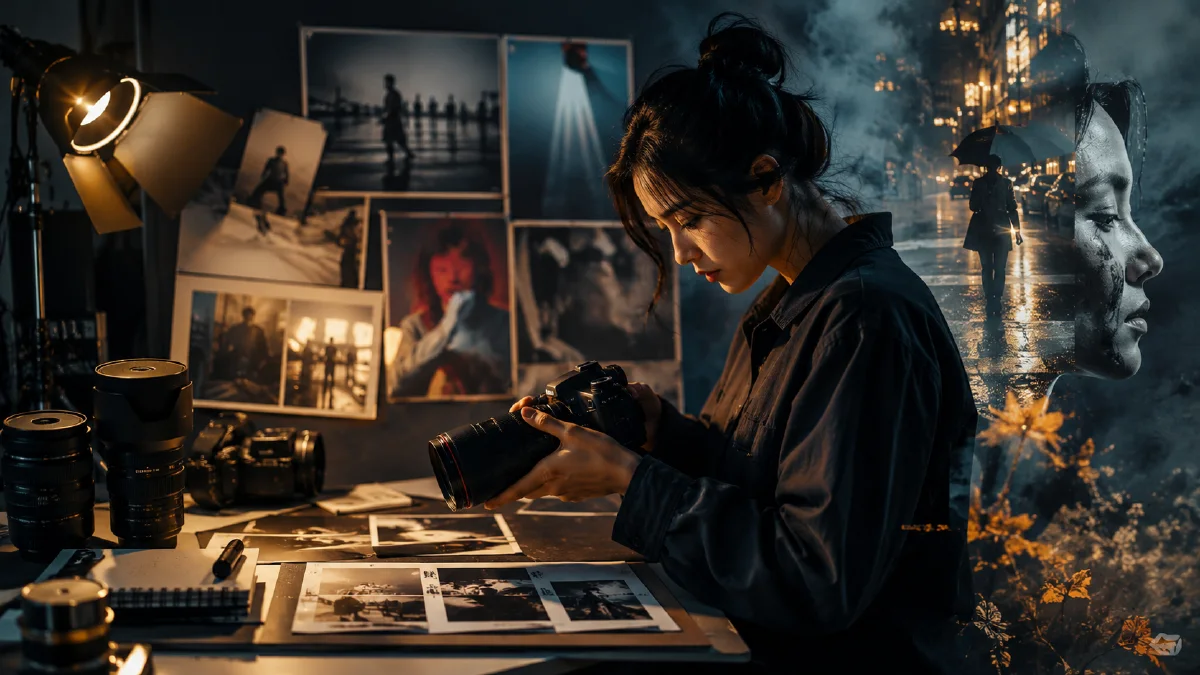
Long exposure, double exposure, motion blur, and intentional grain can make AI images feel less synthetic when used carefully.
Double exposure works best when the two images have a conceptual relationship:
Double exposure portrait of a violinist, the silhouette filled with a night train window scene, outer face contour remains sharp, inner train lights streak horizontally, black background, monochrome silver and amber palette.
Long exposure needs a still element and a moving element:
Street dancer frozen in a sharp pose while colored light trails spiral around the body, long exposure photography, dark studio, crisp face and hands, motion blur only in ribbons of light.
Selective blur is important. If everything blurs, the image looks like a failed render. State what remains sharp.
Make ordinary subjects strange
Unique photography does not require exotic subjects. In fact, ordinary objects are often better because the viewer can appreciate the transformation. A chair, vending machine, phone booth, shoe, apple, glass of water, office printer, or bathroom mirror can become compelling through angle, light, and crop.
Prompt example:
Macro photograph of condensation droplets on a chrome toaster, kitchen reflected upside down in each droplet, shallow depth of field, morning sunlight, surreal but realistic product photography, high detail, no glossy CGI look.
The object is mundane. The view is not.
For brand work, this approach is useful because it lets you create distinctive campaign images without making the product unrecognizable. Keep the product form intact and experiment around it.
Post-processing should have a reason
Film grain, selective color, split toning, high contrast black and white, cross-processing, glitch, and halation can all work. But post-processing should not rescue a weak idea. It should reinforce the camera decision.
If the shot is high contrast and architectural, black and white may help. If the frame is about nostalgia, film grain and warm halation may help. If the image is about surveillance or broken memory, glitch may help. If the subject is a single red object in a gray environment, selective color may help.
Avoid stacking post effects. "Film grain, glitch, VHS, double exposure, infrared, HDR, cinematic, vintage" is not a style system. It is a pile.
From stills to video
Unique photography can become strong video when the photographic decision survives motion. If the still frame is built on a low angle, keep the low angle. If it is built on projection patterns, animate the pattern slowly. If it is built on double exposure, use subtle internal movement rather than a fast camera move.
Example video direction:
Keep the low floor-level camera angle. The subject slowly walks through the projected checkerboard light, shadows slide across the wall, camera remains locked, subtle handheld vibration.
For more complex motion, generate the still first, then continue with image-to-video. This protects the composition before motion begins.
Common mistakes
The first mistake is confusing uniqueness with clutter. A strange photograph can be minimal. In fact, minimal subjects often make the photographic idea easier to see.
The second mistake is using camera terms without relationships. "85mm, wide angle, macro, fish-eye" cannot all be true at the same time. Pick the lens behavior you need.
The third mistake is asking for premium photography but then adding impossible materials, excessive glow, and perfect CGI surfaces. If you want the image to feel shot, preserve physical light, texture, and imperfections.
Try it in Naviya
Use Naviya AI Image Generator to test one photographic decision per prompt. Save strong frames, then animate them through Naviya Image to Video with motion that respects the original camera idea. For example, a projection-light portrait can become a slow shadow movement. A macro product shot can become a tiny focus pull. An overhead still life can become hands entering the frame.
Use case filter
Unique photography should still match the job. Before choosing an unusual trick, decide what the frame must prove.
| Goal | Useful trick | Avoid |
|---|---|---|
| Product premium | macro crop, controlled reflection, selective color | hiding shape behind effects |
| Creator portrait | projection light, off-axis angle, candid crop | damaging facial clarity |
| Event promotion | slow shutter trails, crowd silhouettes, colored haze | unreadable venue or date area |
| Editorial story | double exposure, foreground obstruction, unusual lens | random surreal objects |
If the trick does not strengthen the goal, remove it. The most memorable image is often the one with a single unusual choice executed cleanly.
A reliable structure:
Subject, one photographic technique, exact camera position, light diagram, composition rule, post-processing restraint, what must stay sharp, what to avoid.
Unique photography is not randomness. It is one sharp camera decision made visible.