2026-06-12
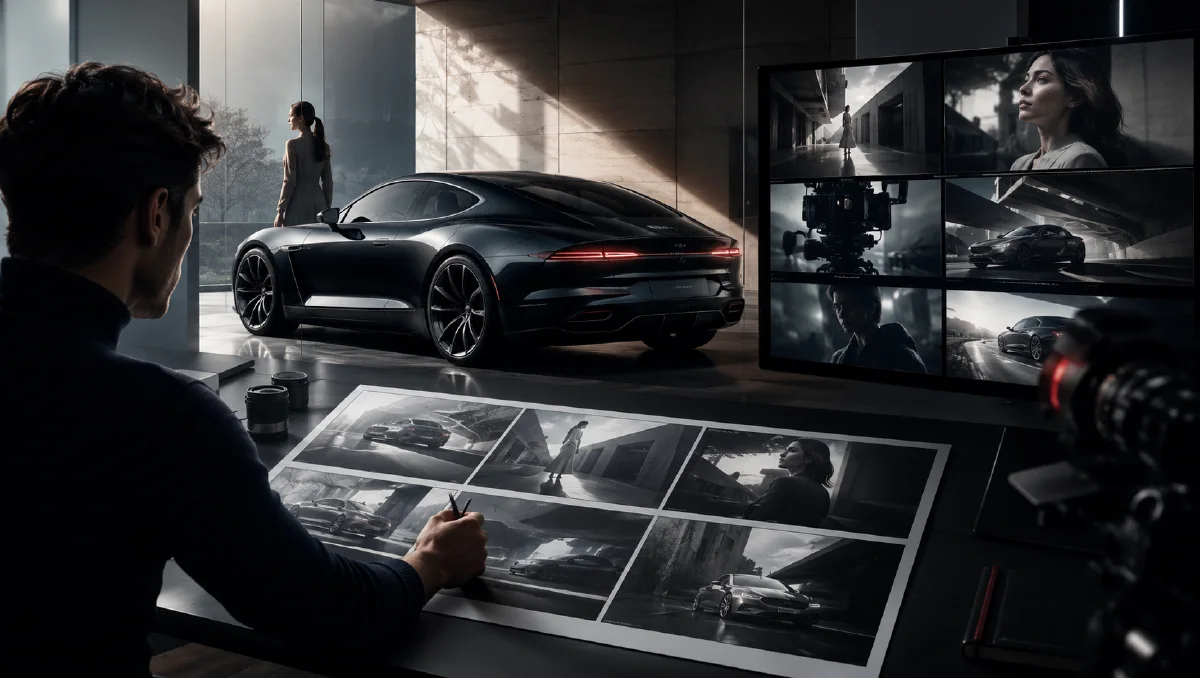
Luxury Car Brand Film Storyboard with AI
Plan a luxury car brand film with AI using architectural scenes, elegant character moments, controlled vehicle shots, and image-to-video prompts.
Try this workflow in Naviya
Start from a finished image when the subject, style, or composition should stay stable.
Animate a still image
Luxury car advertising often sells atmosphere before specifications. Architecture, fashion, light, music, and restrained motion all shape the viewer's perception before the vehicle appears. AI can help plan and produce this type of film, but it works best when you treat the sequence like a storyboard instead of a pile of car shots.
The practical definition: an AI luxury car brand film is a sequence of generated and animated shots that uses environment, character, and vehicle reveal to communicate status, elegance, and design. It can be a concept film, launch teaser, social cut, or pitch asset.
For broader car concepts, see AI sports car commercial workflow and AI miniature landscape car commercial. For camera movement language, use AI video camera movement prompts. For vehicle consistency, use reference to video.
The atmosphere-first structure
A premium car film does not have to reveal the car immediately. It can build a world first:
- Elegant character enters architectural space.
- Light patterns establish mood.
- Details of stone, metal, fabric, or music create texture.
- Vehicle appears as part of the same world.
- Driving shot shows power under control.
- Final hero frame holds the vehicle.
This structure makes the vehicle feel intentional rather than inserted.
Ten-shot storyboard
| Shot | Duration | Visual |
|---|---|---|
| 1 | 2s | Elegant figure in black dress walks through stone alley |
| 2 | 2s | Low-angle view of symmetrical courtyard opening to sky |
| 3 | 2s | Close-up of carved architectural details and shadows |
| 4 | 2s | Figure turns in a Paris-inspired street |
| 5 | 4s | Figure pauses near classical colonnade |
| 6 | 5s | Luxury sedan parked in front of vintage architecture |
| 7 | 3s | Iron balcony detail, patterned shadow |
| 8 | 5s | Sedan drives smoothly through old street |
| 9 | 4s | Cellist performs in classical interior |
| 10 | 5s | Figure walks through square, vehicle presence implied or revealed |
You can compress this into a 20-second edit by selecting five shots: alley, courtyard, colonnade, parked vehicle, driving vehicle.
Style direction
Use a repeated style block:
luxury automotive brand film, classical European architecture,
elegant fashion styling, strong light and shadow, refined contrast,
cinematic composition, premium restrained mood, 16:9
This keeps character, architecture, and vehicle shots in the same visual language.
Character and architecture prompts
Opening shot:
Medium tracking shot of an elegant fictional woman in a long black dress and wide-brim hat,
walking slowly through a narrow stone alley.
Strong sunlight creates dramatic shadow patterns on the wall and clothing.
Luxury automotive brand film atmosphere, classical architecture, refined contrast.
Courtyard shot:
Low-angle wide shot looking up through a symmetrical architectural courtyard,
sunlight pouring from the open sky, stone walls forming elegant geometric lines,
slow upward camera movement, premium cinematic atmosphere.
Colonnade shot:
Medium shot of an elegant figure leaning near classical stone columns,
quiet confident pose, warm late-afternoon light, refined shadow,
luxury brand film mood, minimal movement, no readable text.
These shots create the emotional frame before the car arrives.
Vehicle hero prompts
Parked hero:
Wide shot of a black executive luxury sedan parked in front of classical stone architecture.
The car body lines echo the building facade, glossy reflections, long elegant silhouette,
warm sunlight and deep shadows, premium automotive advertising style.
Camera locked with a very slow push-in.
Vehicle proportions remain stable, no license plate text, no extra cars.
Driving shot:
Wide tracking shot of a black executive luxury sedan driving smoothly through a vintage stone street.
Architecture passes slowly in the background, reflections glide along the car body,
camera follows from front-left three-quarter angle, elegant controlled speed.
No aggressive driving, no extra vehicles, stable car shape.
For a specific car, use a reference image. Text prompts can create a luxury sedan, but they may change grille, lighting, and proportions between shots.
Add a music or performance motif
The cellist shot gives the film rhythm and class without relying on voiceover:
Medium shot of a cellist performing in a classical stone interior,
warm side light, elegant shadows, refined luxury atmosphere,
camera locked, bow moves slowly across strings, cinematic depth of field.
This shot can cut between parked and driving vehicle shots. It suggests craftsmanship, control, and emotional resonance.
Motion principles
Luxury car motion should feel controlled:
- Slow push-in for parked hero shots.
- Smooth side tracking for driving.
- Subtle tilt for architecture.
- Minimal character movement.
- Strong light movement across car body.
Avoid camera shake, fast spins, and dramatic crashes unless the brand concept calls for performance aggression. Executive luxury usually reads better with calm power.
Keep the vehicle reveal earned
The strongest luxury edits make the car feel like the conclusion of the world, not an object dropped into it. The stone alley, courtyard, colonnade, and music motif should all prepare the viewer for the vehicle's design language. If the architecture is curved and elegant, choose car angles that emphasize long lines and reflections. If the environment is severe and geometric, use stronger front views and sharper shadow patterns.
Do not hide the vehicle too long in a short ad. For a 15-second cut, reveal the car by the middle of the video. For a 30-second cut, you can spend the first third establishing atmosphere, but the final third should belong to the car.
Continuity checklist for the edit
Check continuity across shots before final grading:
- Does the character wardrobe stay consistent?
- Does the architecture feel like one district or one design world?
- Does light direction change too abruptly?
- Does the car color remain the same?
- Do reflections match the environment?
- Does the music motif support the transition into the vehicle reveal?
Small continuity mismatches can make a premium film feel like a mood board. Fix them before adding titles or color effects.
Grade for one emotional temperature
Color grading should make the sequence feel like one world. Warm late-afternoon light suggests elegance and nostalgia. Cooler stone light suggests restraint and authority. High contrast black-and-gold grading suggests drama. Pick one emotional temperature and apply it across character, architecture, music, and vehicle shots.
If the car looks glossy and modern while the character shots look soft and vintage, bridge them with shared shadows, reflections, and similar highlight color. The viewer should feel that the car belongs in the same cinematic space.
Keep titles minimal as well. A luxury car film usually needs fewer words, larger pauses, and cleaner typography than a retail ad.
Try it in Naviya
Generate the architectural and vehicle frames in Naviya Image Generator, then animate each shot with Naviya Image to Video. Use Naviya Reference to Video for vehicle consistency, and test shorter campaign cuts in Naviya AI Video Ads.
Final quality checklist
Before finishing the film, check:
- The vehicle appears after the atmosphere is established.
- Character styling and architecture match the car's positioning.
- The car shape remains stable across shots.
- Driving speed feels premium, not rushed.
- Light and shadow language is consistent.
- The final hero frame is clean enough for copy or logo placement.
A luxury car brand film is a choreography of restraint. AI can generate architecture, character, vehicle, and motion quickly, but the premium feeling comes from sequence control: reveal the world, reveal the car, then let the car own the final memory.