2026-06-12
Fantasy Dreamscape AI Prompts: Create Surreal Worlds with Clear Visual Logic
Write fantasy dreamscape AI prompts that combine surreal subjects, impossible environments, supernatural light, and stable composition.
Try this workflow in Naviya
Use the guide to shape a still image, then keep it as a first frame or campaign asset.
Open the studio
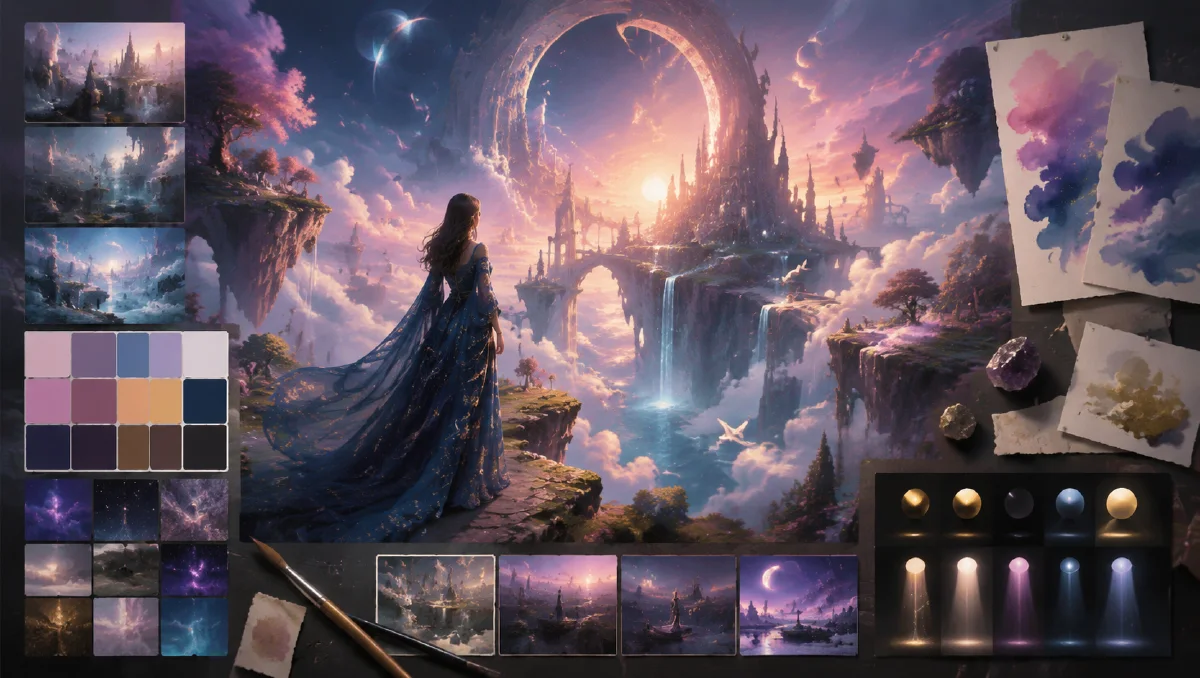
Fantasy dreamscape AI prompts are not just prompts with "dreamy" added at the end. The strongest dream images have their own logic. They combine familiar subjects with impossible scale, strange environments, supernatural light, and selective clarity. A piglet can feel monumental through a fish-eye lens. A goldfish can float through a sky that behaves like water. A child skipping rope can stand in a forest where plants emit their own light.
The goal is to make the viewer feel that the image follows dream rules, not random rules. That means the prompt needs to explain what is normal, what has changed, and which visual details remain sharp enough to anchor the scene.
Use this guide with controlled chaos AI prompts, cinematic atmosphere AI prompts, and AI style extraction prompts when you want a still frame that can later become motion.
Dream logic starts with one contradiction
A common mistake is stacking every surreal idea at once: floating islands, glowing animals, giant moons, melting clocks, neon fog, underwater sky, crystal mountains, and lens distortion. The result may look busy, but it rarely feels memorable.
Choose one primary contradiction:
- A real animal appears at an impossible scale.
- A normal environment behaves like a different element.
- A familiar action happens in a strange place.
- A subject is lit from a source that does not exist in reality.
- The camera sees the world through an unusual perspective.
Then let every supporting detail reinforce that contradiction.
Example:
A small polar bear cub standing in a quiet bedroom where the floor has become a frozen lake, moonlight glowing from beneath the ice, soft snow floating upward instead of falling, gentle pastel blue and cream palette, wide centered composition, dreamlike haze, crisp bear silhouette, blurred room edges.
The image has one main impossible idea: the bedroom floor is a frozen lake. The light, snow, palette, and blur all support it.
Build the prompt in layers
Use this structure:
Subject + dream transformation + environment contradiction + supernatural light + color system + focus behavior + camera perspective.
The subject should be simple enough to recognize. Animals, children, cyclists, swimmers, dancers, vehicles, rooms, and everyday objects work well because the viewer understands what has been altered.
The transformation should be visible, not abstract. "Dreamy" is vague. "A goldfish floating through a hallway filled with suspended air bubbles and ceiling lights refracted like underwater sunlight" is visible.
The environment contradiction makes the scene feel like a dream. A road can become a river. A forest can grow inside a train car. A kitchen can open into a night sky. A staircase can continue into a cloud layer.
The lighting should not be generic fantasy glow. Name the source: bioluminescent plants, inner glow from the subject, aurora light, underwater caustics, moonlight from below, or sunbeams passing through impossible mist.
Distortion should serve emotion
Fish-eye, extreme low angle, macro close-up, and overhead views can all create dream energy. But lens distortion is not decoration. It should change how the subject feels.
Use fish-eye for playful exaggeration, mild unease, or childlike wonder. Use extreme close-up when an animal or object should feel intimate and oversized. Use low angle to make a small subject mythic. Use overhead views when the scene should feel like a diagram or memory.
Prompt example:
Fish-eye close-up of a tiny piglet standing in a field of oversized clover, the nose closest to camera, soft pink skin and wet grass in sharp detail, background flowers stretched into a circular dream blur, warm sunrise haze, pastel green and peach palette.
The lens choice supports the subject. Without that connection, fish-eye can look like a gimmick.
Use color to protect the dream
Fantasy dreamscape color usually sits between softness and surprise. Pastels, misty blues, lavender, cream, pale gold, and soft green create the dream layer. Local accents, such as coral, electric cyan, or glowing yellow, give the image a focal point.
The trick is not to saturate everything. A fully neon dreamscape becomes psychedelic rather than dreamlike. For fantasy dreamscape, keep most colors soft and save high saturation for magical elements.
Useful palette phrases:
- "soft pastel base with one luminous coral accent"
- "cool blue dreamtone with warm golden haze around the subject"
- "muted lavender shadows and creamy moonlit highlights"
- "bioluminescent green details against a low-saturation forest"
For a series, reuse the same palette block across prompts. It will make unrelated scenes feel like they belong to one dream world.
Move dreamscapes carefully
Dreamscape images make strong first frames for video, but motion can break them if the prompt asks the model to animate every strange element. Decide what moves and what stays stable.
Good motion directions:
The camera slowly drifts forward. Floating petals move gently upward. The main subject remains stable and looks toward the light. Background mist shifts softly.
The cyclist pedals slowly across a road that reflects the night sky like shallow water, soft ripples follow the wheels, camera holds a smooth side-tracking motion.
Avoid violent transformations unless the dream is meant to become chaotic. If the subject changes shape, the environment changes material, and the camera spins at the same time, the video will likely lose coherence.
Practical use cases
Fantasy dreamscape works well for music visuals, book covers, wellness branding, children's product concepts, cinematic character studies, surreal product launches, and social posts that need wonder without harsh spectacle. It is also useful when a brand wants emotion but not direct realism.
For product work, keep the product physically stable and let the world around it become dreamlike. For character work, keep the face or costume consistent and let scale, light, and environment shift. For landscape work, use one impossible rule and repeat it across the whole scene.
Common mistakes
The first mistake is using too many fantasy nouns. A dragon, castle, crystal forest, moon portal, floating whale, and glowing waterfall may all be fantasy, but they do not automatically create a dream.
The second mistake is making everything equally sharp. Dreams often feel powerful because clarity is uneven. Keep the subject sharp, soften the edges, and let the far background dissolve into haze.
The third mistake is forgetting camera language. A dreamscape still needs composition, focal length, and perspective. The more surreal the content becomes, the more important the frame structure is.
Keep the dream readable
Dreamscape prompts can become muddy when every part of the world is strange. Protect the viewer by keeping one familiar anchor: a doorway, a bed, a human figure, a product silhouette, a path, or a recognizable horizon. Then let the impossible element happen around that anchor. A floating staircase is easier to understand if the room still has gravity. A moonlit ocean in the sky works better if the subject stands on a clear foreground plane.
Use a one-contradiction rule for commercial work. If the campaign already uses impossible scale, keep the color palette restrained. If the lighting is magical, keep the subject pose simple. If the environment bends, keep the product shape stable. This helps the image feel intentional rather than chaotic.
For still dreamscapes, build the anchor first in the AI image generator. For motion, animate only the dream cue with image to video: drifting stars, slow fabric lift, a doorway glowing open, or a reflection moving in the wrong direction. The creative AI video ideas guide can help you turn the mood into a clearer concept.
Try it in Naviya
Begin with a still image in Naviya AI Image Generator. Use one clear subject, one impossible environmental rule, one light source, and one palette. Once the still image has the right dream logic, animate it in Naviya Image to Video with restrained movement: drift, ripple, floating particles, slow walking, or a gentle camera push.
A strong dreamscape prompt can be short if it is organized:
Recognizable subject, one impossible environment rule, supernatural light source, soft color palette with one accent, selective focus, camera perspective, avoid clutter and random fantasy objects.
Fantasy dreamscape style is not about escaping logic. It is about replacing everyday logic with visual rules the viewer can feel.