2026-06-12
AI Car Ad Workflow for Extreme Environment TVC Scenes
Create AI car ad scenes for deserts, mud, snow, water, and night city shots with storyboard prompts and image-to-video control.
Try this workflow in Naviya
Turn a product, hook, or campaign idea into short social-ready ad concepts.
Create video ad variants
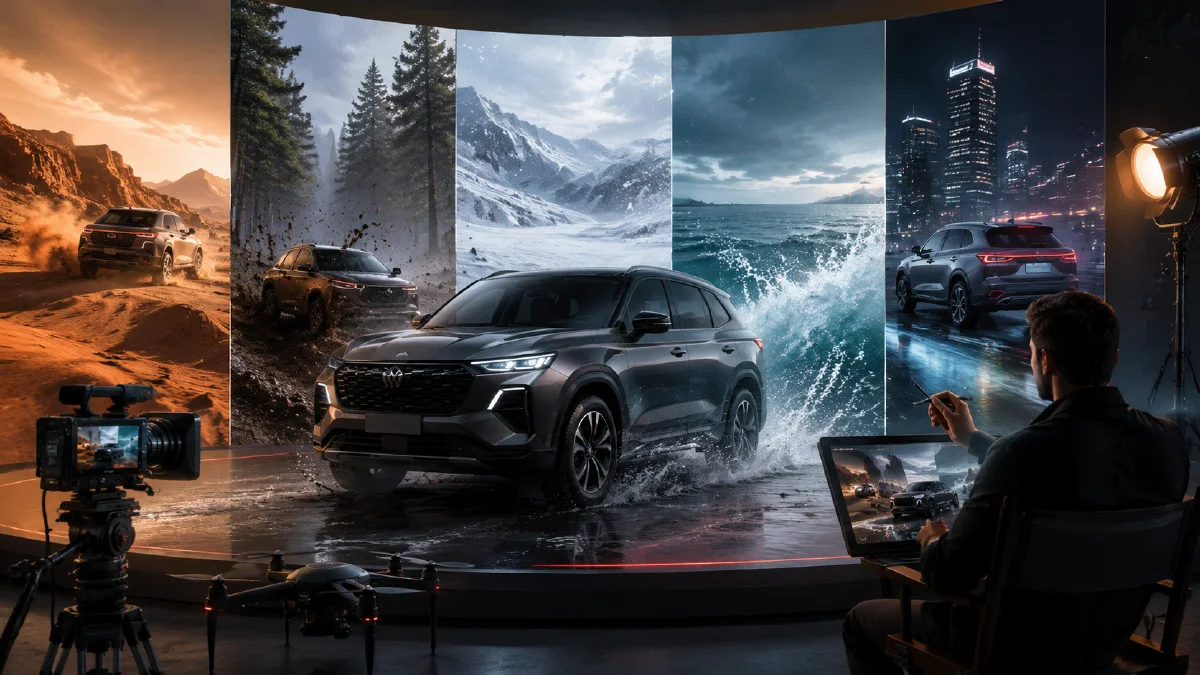
An AI car ad workflow should start with the brand feeling, not the vehicle shot. For a premium off-road SUV, the core message might be fearlessness, control, and the ability to cross difficult terrain. That message can become a sequence of extreme environments: desert, mud, snow, water, and city night. Each location proves a different kind of confidence.
Use AI Image Generator to create storyboard frames, Image to Video to animate each approved shot, and AI Video Generator to assemble the full campaign. For more craft, read cinematic atmosphere prompts, Product Image to Video, and AI lighting prompts.
Define the campaign thesis
Do not begin with "SUV driving in desert, cinematic." That is a shot, not a campaign. Begin with the thesis:
A premium off-road SUV visual campaign about fearless control
across extreme environments, combining vast landscapes,
powerful terrain interaction, and composed luxury design.
This thesis guides every frame. The vehicle should look powerful, but not chaotic. The environment should look extreme, but not so destructive that the car disappears.
Build a storyboard before generating
A car TVC can be planned as a sequence of proof points:
| Act | Environment | Story purpose |
|---|---|---|
| 1 | Desert wide | scale, isolation, adventure |
| 2 | Mud and sand drive | torque, control, off-road strength |
| 3 | Splash close-up | physical power, texture |
| 4 | Snow mountain | endurance, stability |
| 5 | Water crossing | confidence, engineering |
| 6 | Night city | luxury, status, return to civilization |
This structure gives the ad rhythm. The opening wide shot makes the world feel large. The action shots prove capability. The final city shot reframes the vehicle as premium, not only rugged.
Write landscape prompts as establishing shots
The opening desert frame does not need the car immediately. A landscape-only shot can establish scale and make the next vehicle shot more dramatic.
Prompt:
An expansive desert landscape under a clear blue sky,
rolling mountains in the distance, dry desert terrain with sparse vegetation,
vast grand atmosphere, cinematic wide shot, natural sunlight,
high-end automotive commercial style, clean horizon, realistic detail.
This can become the first shot or the background direction for the vehicle reveal. Keep it wide, simple, and readable.
Add the vehicle with terrain interaction
Once the world is established, introduce the car with a clear action.
Prompt:
A premium off-road SUV driving through desert terrain,
mud and sand splashing from the tires, strong controlled motion,
vehicle body remains sharp and recognizable, low tracking camera angle,
wide desert landscape, cinematic sunlight, rugged luxury automotive ad,
realistic dust, powerful but composed atmosphere.
The phrase "controlled motion" matters. AI car scenes can become explosive and messy. A premium SUV ad should show force under control.
Use close-ups for physical proof
Texture close-ups make the action believable: tire tread, mud spray, suspension movement, water displacement, headlight beams, and body reflections.
Close-up prompt:
Extreme close-up of off-road SUV tire cutting through wet mud and sand,
mud particles flying outward, sharp tire tread detail, low camera angle,
cinematic slow-motion automotive commercial, realistic texture,
powerful traction, vehicle body partially visible, no logo distortion.
This shot does not need to show the entire car. It proves the terrain.
Create environment chapters
After the desert sequence, move through distinct environments.
Snow:
Premium off-road SUV crossing a snowy mountain road,
snow powder drifting around the tires, cold blue morning light,
stable composed vehicle posture, vast alpine landscape,
cinematic automotive commercial, luxury adventure mood.
Water:
Premium off-road SUV moving through shallow water,
controlled splash around the front tires, reflective surface,
golden backlight, rugged engineering, cinematic wide shot,
vehicle remains clear and centered, no excessive waves.
Night city:
Premium off-road SUV arriving in a modern city at night,
wet asphalt reflections, clean architectural lights,
subtle neon highlights, composed luxury stance,
cinematic automotive hero shot, space for real typography.
Each chapter should share the same vehicle design and premium tone.
Animate car scenes with camera logic
Car image-to-video prompts need camera position, vehicle motion, and environment motion. Without this, the model may drift, warp the vehicle, or invent inconsistent angles.
Desert driving prompt:
Animate this off-road SUV desert image into a 5 second automotive TVC shot.
Camera: low tracking shot moving alongside the vehicle.
Vehicle: the SUV drives forward with controlled speed, body stable and sharp.
Terrain: sand and dust move naturally from the tires.
Lighting: warm desert sunlight, realistic reflections on the body.
Constraints: preserve vehicle shape, wheel position, color, proportions,
headlights, and body lines. No extra vehicles, no logo distortion,
no impossible camera flip.
Water crossing prompt:
Camera holds a front three-quarter view as the SUV moves through shallow water.
Controlled splash around the tires, reflections ripple on the surface,
vehicle remains sharp and centered, premium calm power, no giant waves.
A car ad can handle more motion than a small product ad, but the vehicle still needs preservation constraints.
Keep brand text out of generation
Automotive campaigns often need model names, slogans, and legal copy. Do not ask the model to create final typography. Reserve space instead:
clean negative space in the sky for real campaign headline,
no generated text, no fake badge text, premium commercial layout.
This keeps the visual usable in a real edit.
Shot-by-shot evaluation rubric
Extreme environments are useful only when they make the car more believable, not less. Review every frame as if it were a proof point in a campaign deck.
| Shot type | What it should prove | Common failure |
|---|---|---|
| Wide environment | The vehicle belongs in the world. | The car floats, ignores tire contact, or has wrong scale. |
| Terrain close-up | Grip, suspension, water, snow, or dust interaction. | The effect hides the wheels or invents broken parts. |
| Cabin or detail | Comfort, control, premium materials. | Reflections become messy or dashboard details drift. |
| Hero pass | The brand feeling: power, calm, speed, or resilience. | Camera is dramatic but the vehicle shape changes. |
When a shot fails, fix the physical relationship before adding more cinematic language. For sand, define tire tracks, dust direction, and low sun. For snow, define compressed tracks, cold air, and controlled wheel movement. For water, define splash height and keep the body panels visible. If you need a broader prompt structure, combine this workflow with AI video camera movement prompts and cinematic atmosphere prompts.
For ad batches, create one conservative Image to Video clip from the cleanest hero frame, then one higher-energy AI Video Ads cut that tests the opening environment. Do not change terrain, car color, and camera move in the same test; you will not know which choice improved the ad.
Try it in Naviya
Use AI Image Generator to create the storyboard frames one environment at a time. Approve the vehicle design before expanding the sequence. Use Image to Video for each shot with clear camera movement and vehicle preservation constraints. Build the full TVC in AI Video Generator once the desert, mud, snow, water, and city beats are working.
The strongest AI car ads are not just collections of dramatic shots. They are visual arguments. Every environment should prove the same promise from a different angle: control, power, and confidence under pressure.